Ophthalmic Clinical Research
Showing 97–117 of 117 results
-
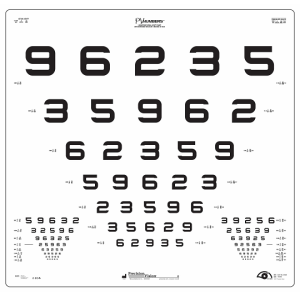
Ophthalmic Clinical Research, Pelli-Robson Trans-Illuminated Contrast Sensitivity Chart
Pelli Robson Trans Illuminated Contrast Sensitivity Chart Low Vision
 Ophthalmic Clinical Research, Pelli-Robson Trans-Illuminated Contrast Sensitivity Chart
Pelli Robson Trans Illuminated Contrast Sensitivity Chart Low Vision
The trans-illuminated versions are identical to the original “Gold Standard” Pelli-Robson Contrast Sensitivity Charts. These charts cover ¾ of the original contrast range and are manufactured to the same true log steps and use the same letters and letter sizes as the originals.
SKU: 5016 -
Ophthalmic Clinical Research, Pelli-Robson Trans-Illuminated Contrast Sensitivity Chart
Trans Illuminated Contrast Sensitivity Pelli Robson Chart SLOAN Peak Contrast Sensitivity Set of 2
 Ophthalmic Clinical Research, Pelli-Robson Trans-Illuminated Contrast Sensitivity Chart
Trans Illuminated Contrast Sensitivity Pelli Robson Chart SLOAN Peak Contrast Sensitivity Set of 2
The trans-illuminated versions are identical to the original “Gold Standard” Pelli-Robson Contrast Sensitivity Charts.
SKU: 5017 -
Ophthalmic Clinical Research, Other charts
BRVT The Berkeley Rudimentary Vision Test
For Visual acuity levels beyond the limit of the letter charts, the common practice is for clinicians to categorize vision according to whether the patient can count fingers (CF) or detect hand motion (HM), but there is no recognized or standard procedures for doing this.
SKU: 4500 -
-
ETDRS charts for Illuminator cabinet 4M ( 13 feet ), Ophthalmic Clinical Research
4 Meter European Wide Series ETDRS Chart 1
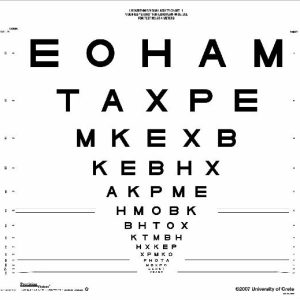 ETDRS charts for Illuminator cabinet 4M ( 13 feet ), Ophthalmic Clinical Research
4 Meter European Wide Series ETDRS Chart 1
To facilitate reliable visual acuity screening for clinical trials and exchange of patient data between doctors, clinics and researchers throughout Europe and beyond, researchers at the University of Crete (Dr. Sotiris Plainis, Prof. Miltiadis Tsilimbaris and Prof. Ioannis Pallikaris), have developed modified ETDRS® charts that contain only capital letters that are common to all three European alphabets (Latin, Greek, Cyrillic), and are thus recognizable for a much wider population.
SKU: 2810 -
ETDRS charts for Illuminator cabinet 4M ( 13 feet ), Ophthalmic Clinical Research
4 Meter European Wide Series ETDRS Chart 2
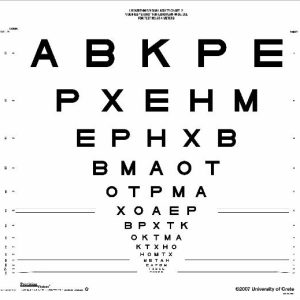 ETDRS charts for Illuminator cabinet 4M ( 13 feet ), Ophthalmic Clinical Research
4 Meter European Wide Series ETDRS Chart 2
To facilitate reliable visual acuity screening for clinical trials and exchange of patient data between doctors, clinics and researchers throughout Europe and beyond, researchers at the University of Crete (Dr. Sotiris Plainis, Prof. Miltiadis Tsilimbaris and Prof. Ioannis Pallikaris), have developed modified ETDRS® charts that contain only capital letters that are common to all three European alphabets (Latin, Greek, Cyrillic), and are thus recognizable for a much wider population.
SKU: 2811 -
ETDRS charts for Illuminator cabinet 4M ( 13 feet ), Ophthalmic Clinical Research
4 Meter European Wide Series ETDRS Chart 3
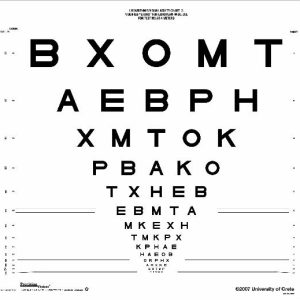 ETDRS charts for Illuminator cabinet 4M ( 13 feet ), Ophthalmic Clinical Research
4 Meter European Wide Series ETDRS Chart 3
To facilitate reliable visual acuity screening for clinical trials and exchange of patient data between doctors, clinics and researchers throughout Europe and beyond, researchers at the University of Crete (Dr. Sotiris Plainis, Prof. Miltiadis Tsilimbaris and Prof. Ioannis Pallikaris), have developed modified ETDRS® charts that contain only capital letters that are common to all three European alphabets (Latin, Greek, Cyrillic), and are thus recognizable for a much wider population.
SKU: 2812 -
ETDRS charts for Illuminator cabinet 4M ( 13 feet ), Ophthalmic Clinical Research
Original Series Sloan Letter ETDRS Chart 2
 ETDRS charts for Illuminator cabinet 4M ( 13 feet ), Ophthalmic Clinical Research
Original Series Sloan Letter ETDRS Chart 2
Only standardized format accepted in studies sponsored by the National Eye Institute.
Designed for use in clinical studies and low vision evaluations where accurate, repeatable visual acuity measurements are required.
SKU: 2112 -
-
Near Vision Chart, Ophthalmic Clinical Research
Colenbrander Reading Card Low Vision and Mixed Contrast English
 Near Vision Chart, Ophthalmic Clinical Research
Colenbrander Reading Card Low Vision and Mixed Contrast English
Continuous text cards simulate everyday tasks and activities that patients may encounter, such as reading the newspaper.
Designed as a simple screen test. The usual question for a reading test is: What is the smallest (black) line you can read? On the contrast card one adds the question What is the smallest (grey) line you can read? The difference between the two measurements will be obvious and can simply be expressed in lines. Preliminary findings indicate a 2 or 3 line difference is normal.
Unrelated simple sentences at 4th grade level.
Serves as an educational tool to demonstrate the effect of contrast deficits to patients and family members.
SKU: 4061_ -
Illiminator Cabinet, Ophthalmic Clinical Research
Large LED Illuminator Cabinet 300
2425LED-300 7 Presets at 3, 10, 40, 85, 160, 320 and 800 cd/m2
This configuration allows for testing vision under several different luminance levels with optional charts in high contrast, low contrast and threshold contrast and different test distances.SKU: 2425LED-300